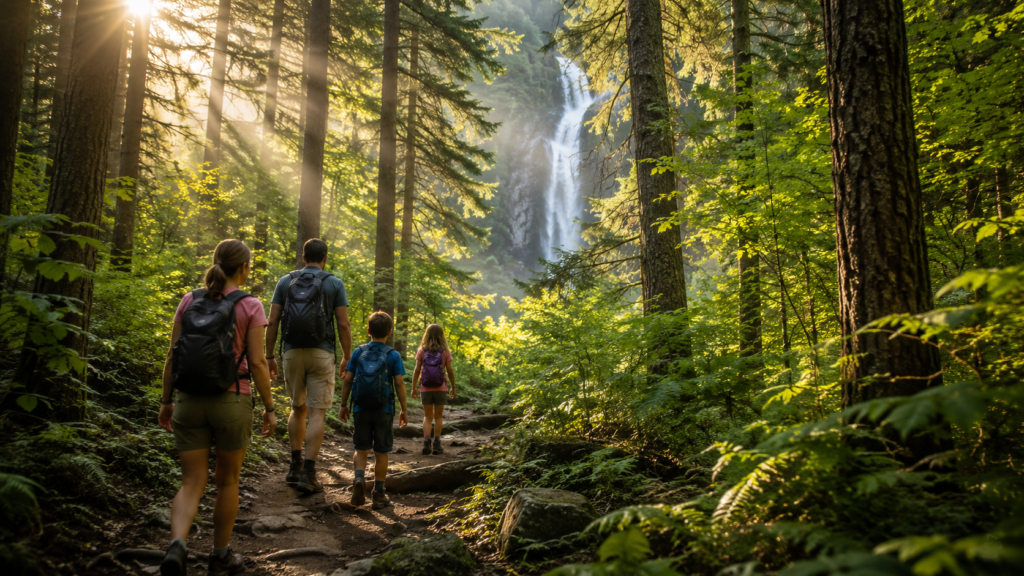
Most people drive past them without knowing they exist. Some hide inside gorges that only reveal themselves to those who wade knee-deep through cold streams. One has a real fire burning inside it. Another flows directly into the Pacific Ocean. A third inspired some of the greatest painters in American history — and still receives fewer visitors in a week than Niagara Falls gets in an hour. These are the hidden waterfalls of America — real places, with real facts behind them, that are so extraordinary they tend to stop people mid-sentence when they first see them.
You don’t need to fly overseas. You don’t need a guide. You just need to know where to look.
1. Eternal Flame Falls, New York — The Waterfall With a Real Fire Inside It
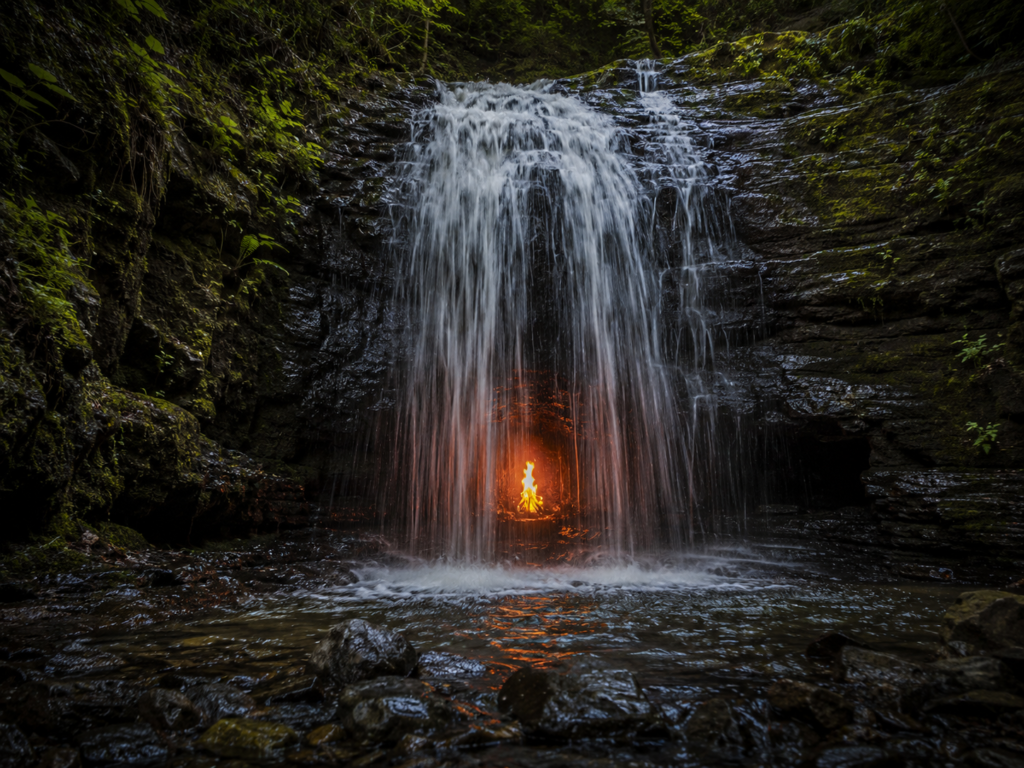
The most jaw-dropping waterfall in America may be one of the smallest. Tucked into Chestnut Ridge Park near Buffalo, New York, Eternal Flame Falls is just 30 feet tall — but hidden in a small grotto behind its cascading water is a real, flickering flame that has been burning for hundreds, possibly thousands, of years.
The flame is fueled by natural gas seeping up through cracks in 400-million-year-old Devonian shale buried roughly 400 meters below the surface. The gas — a potent mix of methane, ethane, and propane — rises through the rock and collects in the sheltered grotto, where it burns continuously unless strong winds push water into the cavity and extinguish it. When that happens, hikers routinely relight it with a match. In 2013, geologists from Indiana University published a peer-reviewed study in Marine and Petroleum Geology noting the seep emits roughly one kilogram of methane per day — and that the flame “may have burnt naturally for many hundreds or even thousands of years.” What puzzled the scientists most was that the shale beneath the falls isn’t hot enough by conventional geological standards to produce natural gas. Something else is happening underground, and researchers still don’t fully understand what.
A video of the flame shot in January 2024 by Buffalo-area photographer Mike Loughran went viral on Instagram, racking up more than 21.7 million views. The rocks surrounding the waterfall contain fossils of sea creatures — shells, ancient sea lilies, and trilobites — from when this part of New York was the floor of a shallow tropical sea 420 million years ago. Bring a lighter, wear waterproof boots, and go in early spring when the waterfall flows strongest.
2. Havasu Falls, Arizona — Turquoise Water in the Heart of the Grand Canyon
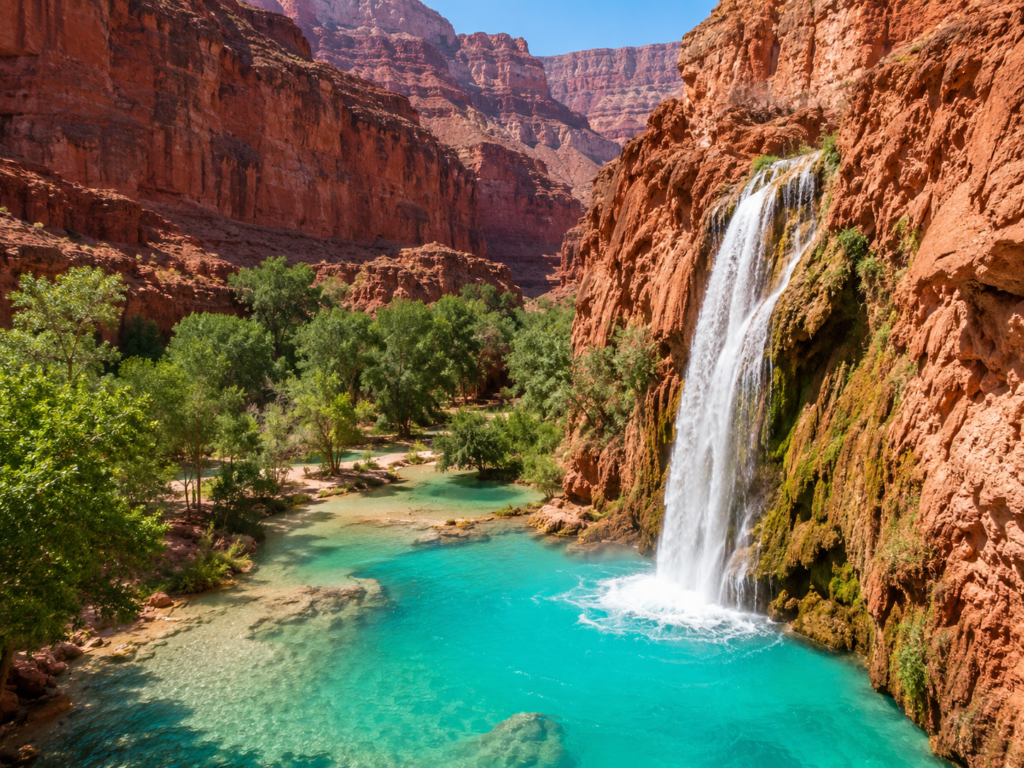
There are waterfalls, and then there is Havasu Falls. Hidden within the Havasupai Indian Reservation deep inside the Grand Canyon, this 100-foot cascade drops into pools of turquoise so vivid that first-time visitors frequently describe the scene as looking computer-generated. The extraordinary blue-green color comes from high concentrations of calcium carbonate and magnesium in the water — the same minerals that make travertine, the stone that lines the pools and builds up in layered shelves beneath the falls over centuries.
The Havasupai people — whose name translates to “people of the blue-green water” — have lived beside these falls for over 800 years. Getting there requires a permit, a 10-mile hike through desert canyon, and advance planning; permits sell out months ahead. But nearly every hiker who makes the journey describes it as the most spectacular place they have ever stood in the United States.
3. Alamere Falls, California — The Waterfall That Flows Directly Into the Ocean
Most waterfalls end in a river or a pool. Alamere Falls, located in Point Reyes National Seashore about 55 miles north of San Francisco, ends in the Pacific Ocean itself — making it one of only two “tidefalls” on the entire West Coast. A tidefall is a waterfall that drops directly onto a beach and into the surf, with the ocean as its final destination.
To reach it, hikers follow the 13-mile round-trip Palomarin Trail through coastal scrub and past two small lakes, scrambling down a short cliff section to reach the beach where the falls spill over a 40-foot sandstone ledge and crash into the waves below. The timing of low tide affects what you see — at high tide, the plunge pool at the base disappears beneath the surf. At sunrise, with the Farallon Islands visible offshore and the waterfall splitting the beach in two, the scene is genuinely unlike anything else in North America.
4. Burney Falls, California — Theodore Roosevelt’s “Eighth Wonder of the World”
When President Theodore Roosevelt visited Burney Falls in Northern California’s McArthur-Burney Falls Memorial State Park, he reportedly called it the “Eighth Wonder of the World.” The claim has become local legend — and standing in front of the falls, it is easy to understand the impulse.
What makes Burney Falls remarkable isn’t just its 129-foot drop, but how it flows. Unlike most waterfalls fed by seasonal runoff, Burney Falls is fed primarily by underground springs that percolate up through the porous volcanic rock of the Cascades. The water seeps out of the cliff face itself — not just over the lip — creating a curtain effect where water appears to emerge from the rock wall on all sides simultaneously. The result is a falls that runs at roughly 100 million gallons per day year-round, even in drought years when every other waterfall in Northern California slows to a trickle. The mist from the plunge pool supports a thriving garden of rare mosses and ferns on the surrounding basalt cliffs.
5. Kaaterskill Falls, New York — The Waterfall That Made America Fall in Love With Nature
At 260 feet in two dramatic tiers, Kaaterskill Falls in the Catskill Mountains of New York is the tallest waterfall in the Eastern United States. But its height is almost secondary to its history. In the early 1800s, this waterfall became the center of the American landscape painting movement, visited and immortalized on canvas by Thomas Cole, the founder of the Hudson River School — whose paintings helped convince a young country that its wilderness was worth protecting. Washington Irving wrote about it. James Fenimore Cooper referenced it in his novels. Kaaterskill Falls is, in a real sense, the waterfall that gave Americans the idea that nature itself was worthy of reverence.
Today, despite this extraordinary legacy, the falls receives a fraction of the visitors that Niagara does. An easy 0.3-mile gravel path from a parking area on Laurel House Road leads to a wheelchair-accessible viewing platform with a full view of both tiers. If you want to stand beside the falls, a separate steeper trail loops to the base. Go in spring or after rain for the full thunderous effect.
6. Grotto Falls, Tennessee — The Only Waterfall in the Smokies You Can Walk Behind
Most waterfalls in Great Smoky Mountains National Park are viewed from in front. Grotto Falls, located in the Roaring Fork area of the park, is the only one where visitors can actually walk behind the curtain of water itself — passing through a moss-covered grotto while 25 feet of cascading water passes just inches in front of their faces.
The 2.6-mile round-trip trail to Grotto Falls runs through old-growth forest of yellow birch and hemlock — one of the few such forests remaining in the eastern United States. The path is also one of the most reliable places in the park to encounter a black bear on the trail, particularly in spring and early summer. Rangers recommend the early morning for both wildlife sightings and solitude.
7. Big Manitou Falls, Wisconsin — The Voice of the Great Spirit
Most people passing through northwestern Wisconsin on the way to Duluth or the Boundary Waters have never heard of Pattison State Park. But hidden inside this small, quiet park is Big Manitou Falls — at 165 feet, the highest waterfall in Wisconsin and the fourth highest waterfall east of the Rocky Mountains, nearly matching Niagara Falls in height.
The Black River drops 165 feet over ancient basalt and rhyolite, dark volcanic rock formed over a billion years ago during a massive continental rift that nearly split North America in two. The Ojibwe people who lived along these rivers for centuries believed the falls carried the voice of Gitchi-Manitou — the Great Spirit — in its roar. Standing at the lower overlook when the river is running full, the sound vibrates through the ground beneath your feet. A simple 0.5-mile trail leads from the main picnic area to multiple overlooks. Admission requires a Wisconsin State Park vehicle pass, typically around ten dollars.
8. Ramona Falls, Oregon — 120 Feet Over a Wall of Volcanic Basalt
Located on the western slopes of Mount Hood, Ramona Falls drops 120 feet over a wall of basalt columns formed by ancient lava flows — creating a curtain effect as the water spreads across the columnar face and falls in dozens of separate silvery streams simultaneously. The surrounding forest of pine and hemlock filters the light into cathedral-like beams on clear mornings.
The 7-mile round-trip trail crosses the Sandy River on a seasonal footbridge and passes through old-growth forest to reach the falls. Early explorers mapped the area in the early 1900s, but the falls remain a favorite of seasoned Pacific Northwest hikers who consider it one of the most photogenic cascades in the country. Go between June and September when the seasonal bridge is in place; the Sandy River crossing is dangerous without it.
9. Bash Bish Falls, Massachusetts and New York — Twin Cascades of a Glacial Gorge
Straddling the Massachusetts–New York border in the Taconic Mountains, Bash Bish Falls drops 80 feet through a dramatic narrow gorge into a pool of clear mountain water. The twin cascades — formed when the stream splits around a central boulder near the top — tumble into a pool surrounded by mossy boulders and dense forest. The gorge was carved by glacial meltwater at the end of the last Ice Age, roughly 12,000 years ago.
Bash Bish Falls is accessible from both states, with parking areas on each side. The Massachusetts approach follows a 1.5-mile trail through the Mount Washington State Forest; the New York side offers a shorter but steeper descent. Swimming is officially prohibited, but the pool at the base draws local swimmers throughout summer. The gorge is most dramatic in early spring, when snowmelt floods the stream and the roar of the falls echoes off the narrow rock walls.
10. Hamilton Pool, Texas — Where a Waterfall Flows Into a Natural Collapsed Grotto
Thirty miles west of Austin, Hamilton Pool Preserve contains one of the most visually surreal natural swimming holes in the United States — a collapsed limestone grotto where a 50-foot waterfall pours from a curved rock overhang into a jade-green pool. The grotto formed thousands of years ago when the dome of an underground river collapsed, exposing the pool below. Ancient cypress trees grow around the edges, their roots gripping the limestone walls, while the overhang above catches the water and channels it into a perfect curtain before it drops.
The pool is famous enough to require advance reservations through the Travis County Parks system, and it sells out on warm weekends. Go on a weekday in early spring for the waterfall at peak flow and the pool nearly to yourself.
The Secret These Waterfalls Share
Every one of these places is real. Every fact in this article has been verified. And every single one of them is within reach of an American road trip — no passport, no expedition gear, no crowded international tour required. The country is full of places this extraordinary that most people drive past without knowing they exist.