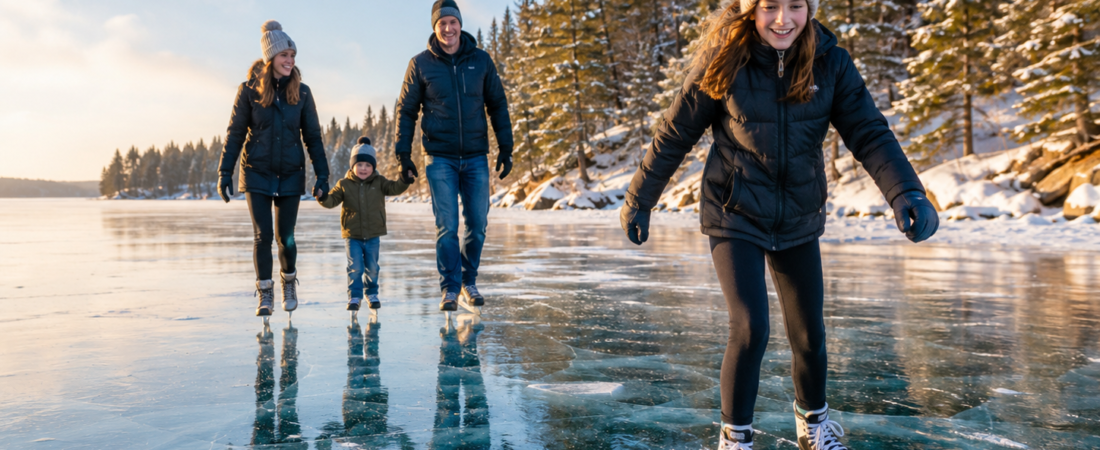
Northern Minnesota is full of frozen lakes — but some of them behave in ways that feel like they belong to another world entirely. When winter clamps down on the Land of 10,000 Lakes, the water doesn’t simply stop moving. It transforms. It glows. It groans in the dark like something alive. And in a few rare places, it turns so clear you can stare straight down into a drowned forest beneath your boots. This is the story of the hidden and mysterious frozen lakes in Minnesota — where the science is as astonishing as the legends, and where the truth, once you learn it, is stranger than any myth.
Why Minnesota’s Frozen Lakes Feel Like Another Planet
Minnesota isn’t called the Land of 10,000 Lakes for nothing — though the real number is even more staggering. The state contains 11,842 lakes larger than 10 acres, and limnologists estimate the true total of all water bodies tops 117,000. Most of them were gouged out by retreating glaciers around 10,000 to 14,000 years ago, leaving behind a pockmarked landscape unlike almost anywhere else on Earth. Wikipedia
When temperatures plunge, those thousands of basins freeze into a vast, silent kingdom of ice. For roughly four to five months of the year, lakes that carried canoes and fishing boats become solid enough to hold trucks, ice-fishing villages, and even plowed roads. The transformation is so complete that the familiar summer world seems to vanish.
What makes them feel mysterious isn’t just the cold. It’s the way the ice plays tricks — turning black and glassy, booming like distant cannon fire, trapping bubbles in frozen columns, and stacking itself into walls along the shore. To stand on a frozen Minnesota lake is to feel the ground beneath you shift, sing, and crack while you walk.
Lake Superior: The Inland Sea That Rarely Surrenders
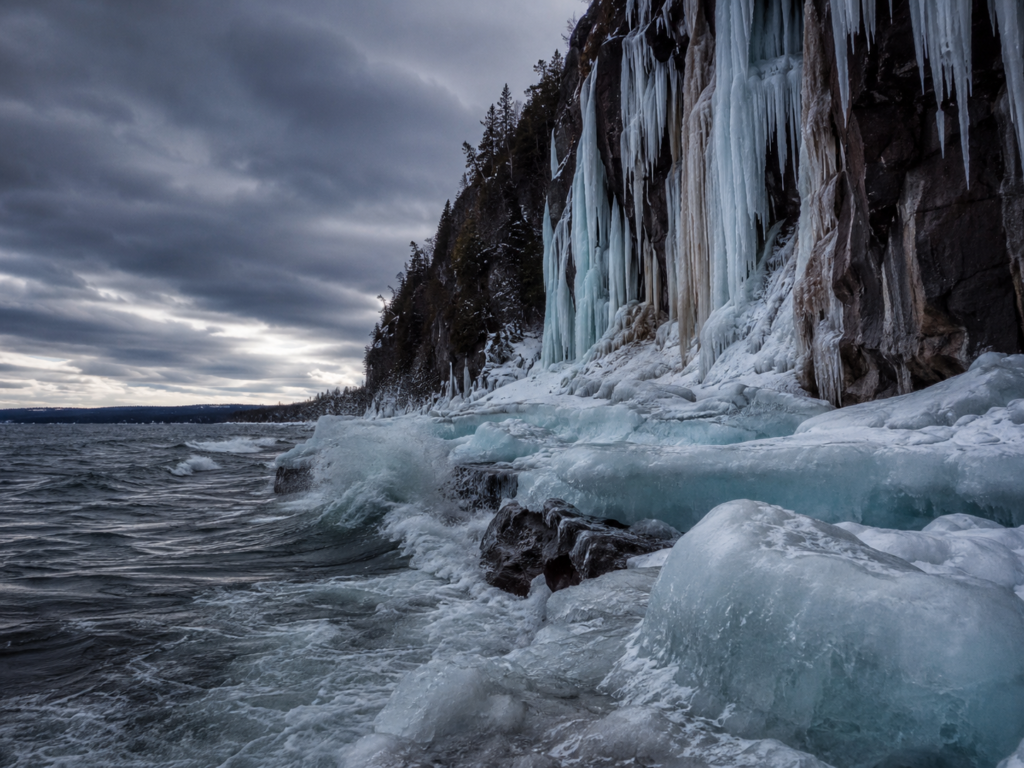
No list of frozen lakes in Minnesota can begin anywhere but Lake Superior — the largest freshwater lake in the world by surface area, sprawling across 31,700 square miles and plunging to a maximum depth of 1,332 feet. It holds about 10 percent of all the fresh surface water on the planet. Visit Cook CountyGreat Lakes Commission
A lake this enormous fights freezing with everything it has. Its sheer volume and depth mean it almost never freezes completely — the closest it has come in recent memory was 2014, when ice cover peaked at 95.3 percent on March 19, according to NASA’s Earth Observatory citing NOAA’s Great Lakes laboratory. By comparison, the U.S. National Park Service notes that “the long-term average maximum annual ice cover on Lake Superior dating back to 1973 is 60%.” National Museum of the Great Lakes
But where Superior’s edges do freeze, the results are spellbinding. Along Minnesota’s North Shore, wind and waves drive water against the cliffs at parks like Tettegouche, where spray freezes onto trees and bushes to create a glittering “ice forest” after storms. Waves crashing ashore freeze into towering stacks of shelf ice, and in extreme conditions, water forced up through cracks builds “ice volcanoes” — cones that can reach 25 feet tall. A Healthier Michigan
Just across the border in Wisconsin’s Apostle Islands, the famous Lake Superior ice caves draw pilgrims when conditions allow — but they almost never do. According to the National Park Service, “from 2000 to 2023, the Mainland Ice Caves were open for only 2 percent of all days,” and the last time stable ice allowed access was “a brief nine-day period in 2015.” Most openings since 2000 have clustered into just four outlier years: 2004, 2008, 2009, and 2014. It’s one of the most fleeting natural spectacles in North America.
The Booming, Singing Ice: Minnesota’s Eeriest Winter Sound
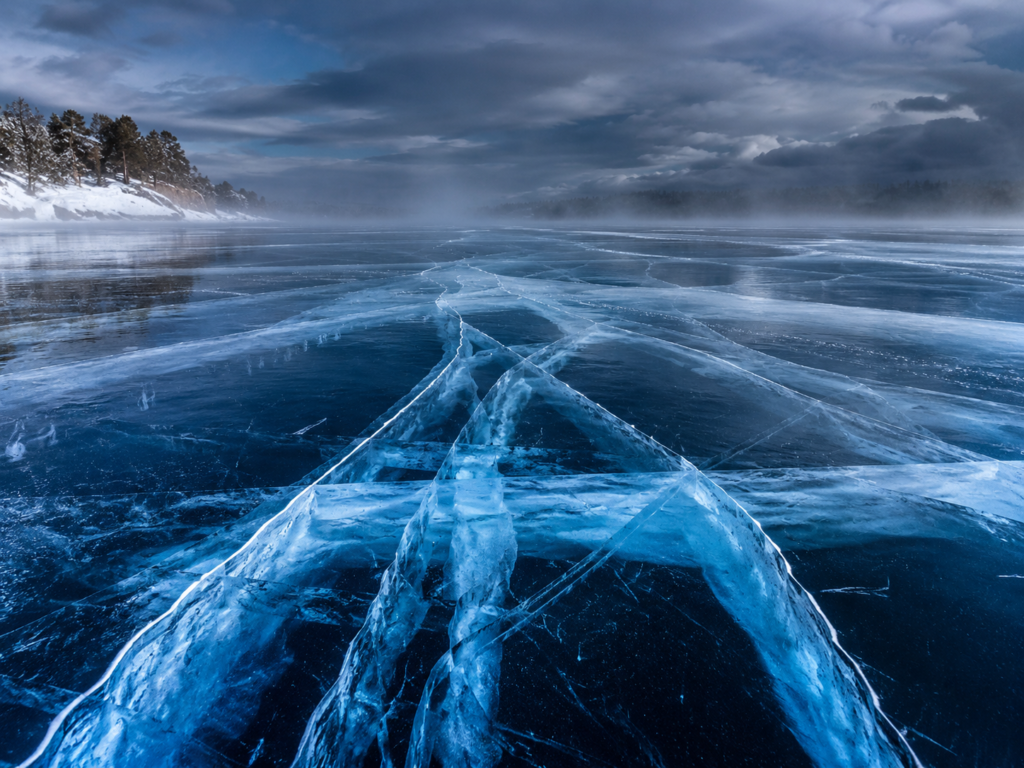
Walk onto a frozen Minnesota lake on a cold, still night and you may hear something that raises the hair on your neck: a deep, echoing BOOM that races beneath your feet and off into the distance, sometimes followed by zings, whines, and pops that sound uncannily like sci-fi laser guns.
The science behind it is beautifully simple. Lake ice expands and contracts with temperature swings. As John Downing, a limnologist and director of the University of Minnesota Sea Grant program, explains in his “Sounds of Ice” column, “the average daily temperature range for northern Minnesota in December and February is about 20°F but it can be as high as 40°F. For a round lake of about a mile across, warming 20°F would expand the ice sheet by about four feet.” That movement builds enormous pressure until something gives way — and the sound rips across the lake.
Downing describes the surface vividly: “You could think of the surface of a frozen lake as a very large drumhead or a giant audio speaker.” The ice amplifies every vibration from below — sometimes, he says, in a booming bass-drum way, sometimes like a sharp snare-drum crack. The bigger the temperature swing, the louder the performance. A 40°F swing — double the figure above — can expand a mile-wide ice sheet by roughly eight feet, a force that has to dissipate somehow.
For the Minnesota ice skaters who chase these conditions, the sound is part of the magic. One Cook County skater described the lake’s voice as making “your heart race a little bit,” while another searched for words and offered only: “Maybe whales.”
Wild Ice: Skating Above a Drowned World
Among all the mysterious Minnesota winter lakes, none feel more otherworldly than those carrying “wild ice.” This rare phenomenon occurs when a lake freezes deep and smooth but no snow has yet fallen to hide it — producing ice so black and glassy that skaters can peer straight down into the water below.
In northern Minnesota, especially around the Boundary Waters and Cook County near Grand Marais, die-hard skaters drop everything when wild ice forms. Strapping on long Nordic blades, they glide for miles across mirror-like surfaces, watching fish drift beneath their feet and submerged logs scroll past like ghosts. One skater told National Geographic that the resistance-free gliding “really is like flying.”
The window is heartbreakingly short. Wild ice typically forms on inland lakes in northern Minnesota during Novembers or Decembers with little snow, and a single snowfall can erase it overnight. When it appears, word spreads fast — and locals describe the resulting reunions on the ice as some of the best skating experiences of their lives.
The Boundary Waters: A Million Frozen Acres of Silence
The Boundary Waters Canoe Area Wilderness sprawls across more than 1 million acres of northeastern Minnesota, containing over 1,100 lakes carved into some of the most ancient exposed rock on Earth — part of the Canadian Shield, with stone up to 3 billion years old. Wikipedia
In summer it’s the most visited wilderness in the United States, a paddler’s paradise. But in winter, the canoes vanish and the entire landscape goes utterly still. Across a million acres of frozen lakes and snow-laden forest, the wilderness settles into a silence you can experience nowhere else, broken only by the howl of wolves crossing the ice and the groan of shifting lake ice. Visitors travel by dog sled, cross-country ski, and snowshoe across waters that have frozen solid.
It’s also here, on lakes like Brule, that wild-ice skaters venture deepest — and where the danger is most real. One skater recounted breaking through the ice in 10-degree weather and having to strip and change every piece of clothing to survive. The beauty and the peril are inseparable.
Voyageurs: Where You Can Drive Across a Frozen Lake
At Minnesota’s far northern border sits Voyageurs National Park, where roughly 40 percent of the park is water. In winter, the giant lakes — Rainy, Kabetogama, Namakan — freeze so thick that the National Park Service plows actual ice roads across them.
The Rainy Lake Ice Road runs about 7 miles, and the Kabetogama–Ash River route stretches even farther. The ice must reach a minimum of 12 inches thick before the roads open, typically from mid-January through mid-March. Drivers describe the surreal experience of motoring past the boat dock onto open ice, listening to the constant pops and cracks reverberating beneath their tires.
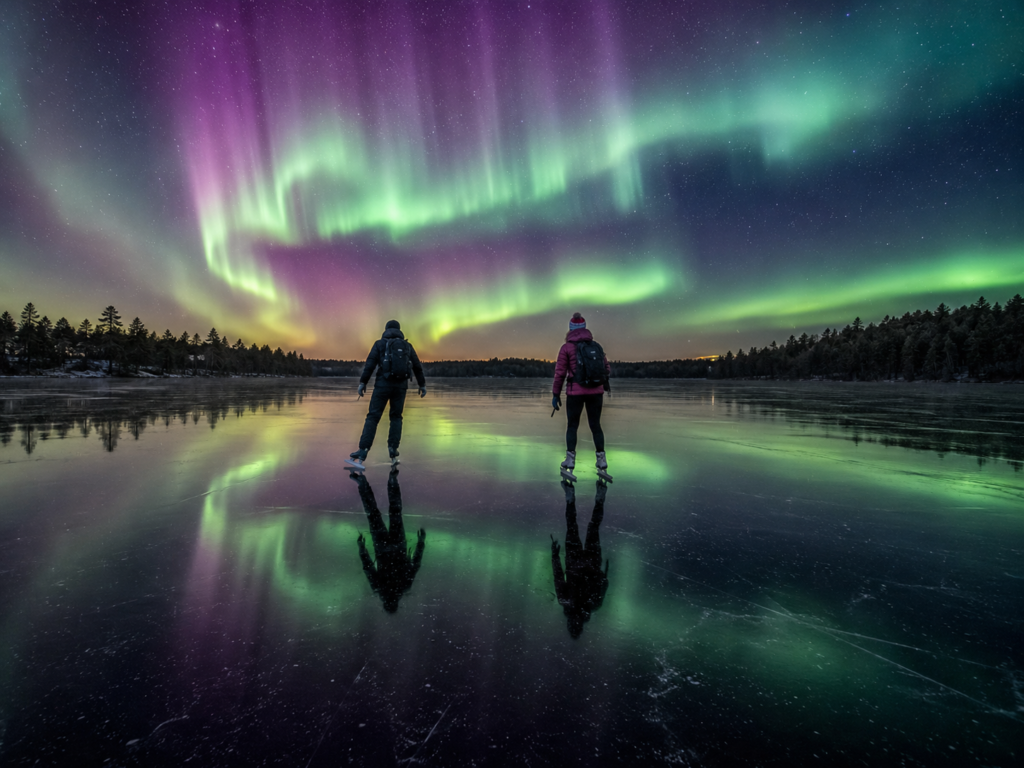
Voyageurs is also one of the best places in the lower 48 states to witness the northern lights, and it’s a certified International Dark Sky Park. On a clear winter night, the aurora reflects off the frozen lake surface, doubling the display — green light shimmering both above and below the horizon of ice.
The Hidden Lake That Wasn’t: The Truth About “Lake Weller”
Here’s where the story takes a genuinely strange turn — and where the mystery of Minnesota’s frozen lakes collides with the modern world.
You may have seen the viral tale: a haunted northern Minnesota lake called “Lake Weller,” where a school bus crashed more than 50 years ago, and where café regulars warn that you must never approach in winter because voices can still be heard beneath the ice. It’s a chilling, beautifully written story. It is also completely fabricated.
The twist within the twist? There genuinely is a small, real Weller Lake in Minnesota — tucked away in Koochiching County near International Falls, covering about 1.99 square miles at an elevation of 1,184 feet. But it has no school-bus tragedy, no haunted café, and no voices beneath the ice. The real mystery isn’t a ghost story. It’s how easily an AI-spun legend can attach itself to a real, quiet, frozen northern lake — and how the actual science of singing ice is eerie enough without any invention at all.
Hidden Dangers and Strange Phenomena
The genuine dangers of Minnesota’s frozen lakes are far more real than any ghost. The Minnesota Department of Natural Resources is blunt: ice is never 100 percent safe. The agency recommends a minimum of 4 inches of new, clear ice for walking, 5 to 7 inches for a snowmobile or small ATV, and 8 to 12 inches for a car or small truck — but warns that ice “may be a foot thick in one location and only an inch or two just a few feet away.”
The most insidious threat is the pressure ridge — a wall of ice that forms where expanding sheets collide and buckle, sometimes towering 10 feet high on lakes like Upper Red Lake. The sheet pushed underneath often floods, leaving thin ice or open water hidden right beside a solid-looking ridge. These can form in just a few hours.
There’s also shelf ice, which piles up on big lakes and conceals deadly air pockets, and honeycomb ice in spring, which shatters at the slightest pressure. And on shallow, organic-rich lakes, methane gas from decomposing plant matter rises and freezes into stacked, ghostly white columns trapped in the ice — a phenomenon documented across north-temperate lakes in Minnesota and Wisconsin by the U.S. Geological Survey. That trapped gas is genuinely flammable.
Best Time to Visit and What to Expect
For the singing ice and wild-ice skating, target late November through December, when northern lakes freeze early and snow hasn’t yet fallen. For the Lake Superior ice forests and shelf ice along the North Shore, mid-February to early March is most reliable. Voyageurs’ ice roads typically run from mid-January to mid-March, and Boundary Waters winter trips peak from January through March.
Whatever you do, treat the ice with respect. Check conditions with local outfitters and resorts, never trust ice just because someone else walked on it, and carry ice picks, a rope, and a change of clothes. Dress for genuinely extreme cold — northern Minnesota routinely drops far below zero, and Voyageurs has recorded a low of -55°F.
A Final Word: The Quiet That Speaks
There’s a moment, standing alone on a frozen Minnesota lake, when everything goes silent — and then the ice speaks. A boom rolls beneath your feet from somewhere far across the dark. The sound moves through your body before it reaches your ears. For just a second, every old legend feels true.
That’s the gift of these hidden frozen lakes. You don’t need a haunted ghost story to feel awe here. The science itself — water building pressure until a mile of ice cracks like thunder, bubbles of ancient gas frozen mid-rise, a million acres falling silent under snow — is enough to make you believe the land is alive. Minnesota’s frozen lakes don’t need to be invented. They only need to be witnessed. And once you’ve heard the ice sing, you’ll never look at winter the same way again.